Logo
  • Proxies
  • Pricing
  • Locations
  • Learn
  • API

LangGraph Proxy

Graph-Based LLM Workflows with Proxy-Enabled Data Pipelines
 
arrow22M+ ethically sourced IPs
arrowCountry and City level targeting
arrowProxies from 229 countries
banner

Top locations

Types of LangGraph proxies for your tasks

Premium proxies in other Academic & Research Solutions

LangGraph proxies intro

LangGraph Proxy: Graph-Based LLM Workflows with Proxy-Enabled Data Pipelines

LangGraph extends LangChain with graph-based state machines that orchestrate complex, multi-step LLM workflows. When these workflows need live web data — for research agents, verification chains, or adaptive scraping — proxy infrastructure becomes a critical dependency. Each node in a LangGraph execution may fetch different URLs, follow different paths based on content analysis, and maintain state across dozens of sequential web requests. Standard proxy setups that treat each request independently cannot support this level of orchestration.

GSocks provides proxy services architected for stateful, graph-driven workflows — offering session persistence across node transitions, async-compatible endpoints for parallel branch execution, and retry policies that integrate with LangGraph's built-in checkpoint and resume mechanism.

Building LangGraph State Machines with Proxy-Powered Retrieval Nodes

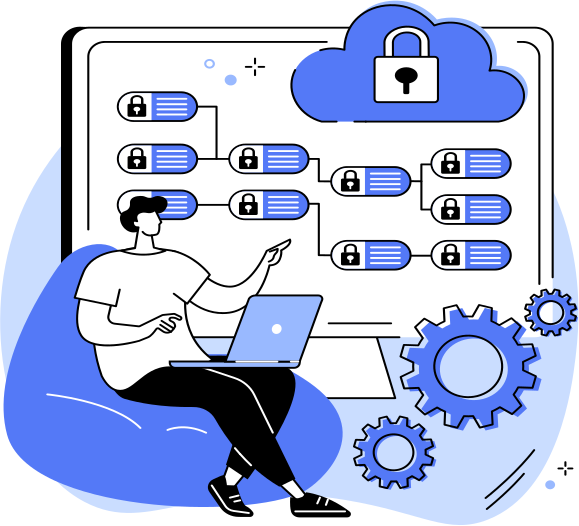
LangGraph workflows model data pipelines as directed graphs where each node performs a discrete operation — fetching a URL, parsing content, querying an LLM, or making a routing decision. Web retrieval nodes within these graphs need proxy connections that respect the workflow's statefulness. When a research agent follows a chain of links across multiple nodes, the proxy session should maintain IP consistency to avoid triggering mid-session blocks on sites that track visitor continuity.

Our proxy integration for LangGraph provides session-scoped connections that persist across node boundaries. When you initialize a GSocks session at the start of a graph execution, every retrieval node within that run shares the same sticky IP. If the graph branches into parallel paths, each branch receives its own session with an independent IP, preventing cross-contamination between concurrent execution threads.

For graphs that execute over extended periods — research workflows that run for minutes or hours — our session renewal API lets nodes request IP rotation at logical breakpoints without disrupting the overall execution. This is particularly important for adaptive scraping flows where the graph discovers new targets dynamically and needs fresh IPs to avoid accumulating reputation damage on a single address.

Edge Features: Stateful Execution, Conditional Branching

Stateful Graph Execution. LangGraph maintains a state dictionary that flows between nodes, accumulating data and decisions throughout the workflow. Our proxy integration stores session metadata within this state — connection handles, IP assignments, and request counters travel with the graph's state object. This means proxy context survives node transitions, conditional branches, and even graph interruptions without requiring external session management infrastructure.

Conditional Branching. LangGraph's power lies in conditional edges that route execution based on runtime decisions. An agent might branch to different scraping strategies based on whether a target returns HTML or JSON, requires authentication, or serves a CAPTCHA. Our proxy endpoints return structured error metadata that LangGraph condition functions can evaluate directly — distinguishing between IP blocks, rate limits, content-type mismatches, and genuine target errors so the graph can route to the appropriate recovery path.

Checkpoint/Resume Support. Long-running LangGraph workflows benefit from checkpointing — saving state at intermediate nodes so execution can resume after failures. Our proxy sessions support serialization into LangGraph's checkpoint format, preserving IP assignments and request history across save/restore cycles. When a workflow resumes from a checkpoint, the proxy layer restores the same session parameters rather than starting fresh, maintaining continuity with the target site.

Strategic Uses for LangGraph Proxy Integration

AI research agents built on LangGraph follow multi-hop information trails — starting from a seed query, fetching results, extracting entities, searching for related sources, and synthesizing findings. Each hop requires a proxied web request, and the chain may extend to 20 or more sequential fetches. Our session management ensures these chains maintain consistent proxy identity across hops, while geographic targeting lets agents access region-specific sources by routing through local IP pools.

Multi-Step Verification Agents

Fact-checking and verification workflows cross-reference claims against multiple independent sources. LangGraph models this as a graph with parallel verification branches that converge at a synthesis node. Each branch scrapes a different source through our proxy pool with independent sessions, preventing a block on one source from cascading to others. The graph's conditional logic can route around blocked sources and extend verification to alternative targets automatically.

Adaptive Scraping Flows

Traditional scrapers follow fixed extraction patterns. LangGraph-based scrapers adapt in real time — an LLM node analyzes page structure, generates extraction rules, and routes to specialized parsing nodes based on content type. Our proxy infrastructure supports this dynamism by providing fresh sessions for newly discovered targets and maintaining established sessions for known-good sources, all managed through the graph's state without external coordination.

Evaluating a LangGraph Proxy Vendor

Async Node Support. LangGraph executes nodes asynchronously when the graph topology allows parallel branches. Your proxy vendor must support concurrent async connections without blocking — a synchronous proxy client inside an async node degrades LangGraph's parallel execution to sequential processing. GSocks provides native asyncio-compatible endpoints tested against LangGraph's async executor at concurrency levels exceeding 100 simultaneous nodes.

Session Persistence. Verify that the vendor supports session handles that can be stored in LangGraph's state dictionary and restored across node boundaries. Simple per-request rotation breaks stateful workflows. GSocks sessions are identified by serializable tokens that LangGraph nodes can pass through state, maintaining proxy continuity without external session stores.

Retry Policies. LangGraph's built-in retry mechanism needs proxy-aware failure classification. Your vendor should return structured error responses that distinguish retriable failures (temporary blocks, rate limits) from permanent ones (invalid targets, authentication required). GSocks error responses include machine-readable status codes that map directly to LangGraph retry/fallback routing decisions.

GSocks offers LangGraph-optimized proxy plans with Python SDK integration, async session management, and workflow architecture guidance. Contact us to design a proxy configuration for your agent pipeline.

Ready to get started?
back